

- Katy Patrick
- Knowledge Base
Headings are used to ensure that author, narrator, series and subject entries are consistent from one bibliographic record to the next. Heading Maintenance allows you to add, merge and delete heading authority records.
Note: This function is intended for catalogers and KLAS admins. If you are not sure whether you have the authority to make these types of changes for your library, please clarify with a supervisor before making any changes in Headings Maintenance.
This document includes instructions on:
- Finding Heading Maintenance
- Adding a new Author or Narrator Heading
- Adding a new Series or Subject Heading
- Modify a Heading
- Merge Headings
- Delete Headings
- Adding MARC Data
- Dewey Decimal Mapping
Download:
Please log in to download content. Thank you!Resources:
For instructions on adding or removing a Subject Heading from a batch of titles, see:
How do you use Headings Maintenance? Share your tips in the comments--or let us know if you have questions!
- Andrea Ewing Callicutt
- Knowledge Base
Instructional Resource / Materials Center staff who use KLAS were invited to attend the KLAS IRC Users' Meeting on Wednesday, October 15, 2025 prior to the start of the 2025 American Printing House for the Blind Annual Meeting.
Slides:
Recording:
- Katy Patrick
- Knowledge Base
The Batch Receive function allows you to easily add Equipment inventory in KLAS.
To add a Range of machines, they must be a complete sequence (common for boxes of new equipment), and must have numeric serial numbers, not alpha-numeric such as the EBZ braille readers. For non-sequential and/or alpha-numeric equipment, the Single option must be used.
Download
Please log in to view available downloads. Thank you!
Remember: You are always welcome to call or email Keystone Customer Support with questions!
- Katy Patrick
- Knowledge Base
The Customer Support team is always happy to answer questions--but sometimes you just want to sit down with a KLAS expert and take a look at something. On Wednesday, June 18 we invited KLASUsers to challenge Katy's KLAS knowledge and get the answers to all their nagging questions during this informal webinar.
Didn't make it? Don't worry--this webinar was recorded and posted to KLASusers. Below are the chat, links to articles with more informations about some of the topics we discussed, and the webinar recording.
Chat
Relevant Articles / Forum Posts
- How to adjust the font size in KLAS
- KLAS Keyboard Shortcuts
- Readership and Circulation Report info
- Rush Item Update - discusses allowing Patron WebOPAC "Rush" requests pushed to the top of patrons' Service Queues!
- Getting Smart about Series - options for how KLAS' Nightly AutoSelect could better approach assigning series
- Auto-adding Service Queues Forum post
- KLAS Admin Training Info
Webinar Recording
- Andrea Ewing Callicutt
- Knowledge Base
On the afternoon of Tuesday, March 18, David Andrews, Chief Technology Officer, Minnesota State Services for the Blind presented a hybrid session titled "Braille: A Format for the Future" during the 2025 KLAS Users' Conference.
This session provided an overview and brief history of paperless Braille devices, explored the evolution of the eBraille format, including the who, what, when, where and how, as well as the development of other formats, such as DAISY and ePub which led to it. David then spoke about about the implementation and what the future looks like.
For those unable to attend the conference or the session, you will find the recording of David's presentation below:

- Andrea Ewing Callicutt
- Knowledge Base
Below are the slidedecks and recordings of the libraries for the blind and print disabled (LBPD) and instructional resource / materials center (IRC / IMC) KLAS New Features Sessions held on Tuesday, May 18, 2025 at the 2025 KLAS Users' Conference.
LBPD New Features in KLAS
IRC / IMC New Features in KLAS
- Andrea Ewing Callicutt
- Knowledge Base
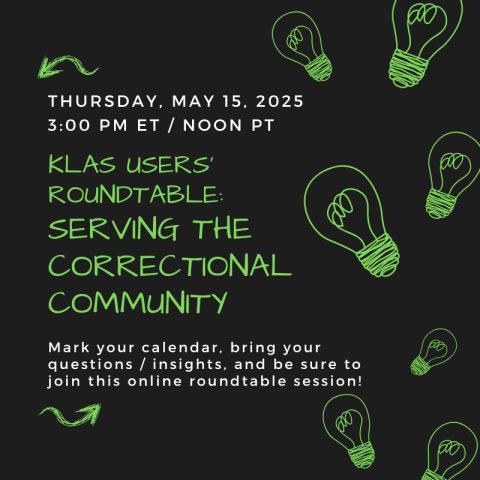
The KLAS Users' Program Committee held a free, online, roundtable on Thursday, May 15. During this session, KLASUsers from three libraries for the blind and print disabled (LBPD) discused how they use KLAS to provide materials to incarcerated individuals and how state / institutional policies effect circulation. Below are the slidedecks and recording of this session.
- What: KLASUsers' Roundtable: Serving the Correctional Community
- When: 3 PM ET / Noon PT Thursday, May 15
- Who:
- Jason Richmond & Emily Tracey, North Carolina Accessible Books & Library Services
- Andrea Loughry, Colorado Talking Book Library
- Judy Gray, Indiana Talking Book and Braille Library
- Katy Patrick, Keystone Systems
Slidedecks
Recording
- Katy Patrick
- Knowledge Base
Imagine this: you've just done a successful outreach program with the local TVIs (Teachers of the Visually Impaired), and now you have a stack of applications for new Juvenile patrons. Wonderful... right up until you realize that you need to enter all of the exclusions for each of them. If you're picturing spending all afternoon entering them one at a time, and worried that you'll miss one of the little 'exclusion' checkboxes along the way, I have good news!
The Quick Preference function allows you to enter all of your common exclusions at once, either by typing them in or by copying and pasting the whole list for juveniles, incarcerated patrons, and anyone wanting just the "clean reads."
And it's not just for exclusions, either--if you learn or create a cheat sheet for your library's top 5 to 10 subject codes, you can save yourself a whole lot of time when entering preferences for your new patrons.
One-time Prep:
Create a list of popular subjects and exclusions, either by looking up the subjects on the patron Preferences tab and jotting down the code, or from the Headings Maintenance screen. See the download below for specific instructions, or your KLAS Admin would likely be glad to create a list of common subject and exclusion codes for your library.
Using Quick Preferences:
From the patron's Preferences tab (Alt-4) in the Patron module, open the Quick Preferences screen from the Functions - Preferences menu or by pressing Ctrl-Alt-n on your keyboard. Enter each code on its own line, and put an exclamation point ahead of any exclusions to say "No!" to that subject. For example, an exclusion against Westerns would be entered as !WES for "No Westerns."
For more detailed instructions, download the full Quick-Tip:
Please log in to download content. Thank you!Tips & Tricks
One option for an easy cheat-sheet is to use a blank application, and write the code next to each preference's checkbox. This ensures that you have the codes handy for everything on the application, and makes it easy to match up the codes to the application you are entering.
For easy copying/pasting of all the standard exclusions, you can also create a notepad .txt file with each exclusion on it's own line, prefixed by an exclamation point (for No!). For example, if my library's codes for Contains Violence, Contains Strong Language, and Contains Descriptions of Sex are VI, ST, and SE, my text file would be:
!VI
!ST
!SE
and so on through all the other exclusions.
I would then Save that file on my desktop or in my documents folder, and every time I entered applications from then on, I would open the file, select the whole list, and press Ctrl-c to Copy it. Any time a patron needed the whole list, or at least most of it, I would then use Ctrl-v on the Quick Preferences screen to Paste the list.
Do you use Quick Preferences? Do you have a lengthy subject code cheat-sheet on your desk, or do you have the codes for just the things on your standard application memorized? Share your tips in the comments--or let us know if you have questions!
- Katy Patrick
- Knowledge Base
How to count Active Patrons is one of those deceptively simple questions. Are you looking at just the patron main status, whether any activity was done on or by the record, or only those patrons that received a book? Does it matter what they received, or from where? Do you count everyone active right now, or everyone who has active at some point during the period? The exact definition of any given 'Active Patron' count will generally explain why these types of counts often differ.
As an example, and to help you understand NLS' upcoming data on patron growth, here's how their numbers were reached.
NLS Circ Status Summary
In the NLS Circ Stats Summary file we ran for everyone in October, the top portion includes a readership summary along these lines:
| Library | Total | Audio - Book or Mag | Braille - Book or Mag | E-Braille - Book | Network Library Collection | % NNNN |
| FL1A | 9,256 | 6,618 | 74 | 51 | 4,567 | 15% |
This leads with the total count of patrons at each library who "were served" according to their Last Served Dates (9256 patrons at FL1A).
The next columns are counting the number of unique patrons who received something from that library in that format (so 6618 audio books or magazines, 74 hard copy braille, 51 e-braille, 4567 from non NLS materials at FL1A). You can't add those numbers up because some patrons can be active in multiple formats, receiving both hard copy and e-braille, or both e-braille and audio books, etc.
The last column is "%NNNN," which is the percent of patrons who are active ("were served"), but did not receive something from that library in any format (15% at FL1A). For the total Active Reader count for your library, NLS will consider your Total active patrons count minus this percent. At FL1A, 9256 minus %15 leaves 8618: the total number of patrons who received something from FL1A specifically.
So why are some of your patrons getting their Last Served Date in at least one medium set, but not receiving anything from your library?
The biggest reason would be BARD. NLS did not want us to include the BARD transactions in the circulation data extract on the theory that they already had that information. So, if you have patrons who solely serve themselves through BARD, the loading of the BARD transactions updates their Last Served Dates--but NLS is only counting them on the BARD side, not in the count for your library.
Another possibility would be those patrons who signed up for a non-TBT subscription that was directly mailed. Since you started sending out MoC serials by Duplication, they shouldn't be a factor for the audio magazines portion. However, the braille magazines are still sent directly from NLS, and are not included in this report either.
Readership & Circulation
For further illustration of how much all of these little differences in definition affect the final numbers, consider the Readership & Circulation Report.
On the R&C Report, the top section (Active Individual Readers and Active Institutional Accounts) is looking at patrons who are marked Active, or who have had their status changed at some point during the reporting period. The theory here is that you've had to work with those patrons in some way, so they should be counting toward your working total.
However, this is not "readership," which is what those Circulation numbers are looking at. The Readership section of the report is a little further down from the top. Here you'll see the patrons in each Medium, broken out by individual versus institution. So, you'd need to add those together to get the numbers for each medium. But once again, you can't just total each column to get the number of active patrons. What you'll get is the total number of active Media Profiles, and as you know, each patron can and often does have multiple Profiles on their record.
So what does all of this mean?
- The Active Individual Readers count from the R&C Report is an accurate count of how many patrons at your library are in Active status or who you worked with in some way. (As long as it is run as closely as possible to the end date of the report. Running it any other time opens up a very large can of worms!)
- The initial Total from the NLS Circ Stats Summary is an accurate count of how many patrons at your library were served reading material of some kind.
- The initial Total minus the %NNNN is an accurate count of how many patrons were served reading material of some kind by your library specifically.
Each is a count of Active Readers--but because each is defined and figured differently, you can expect each number to be different. None of them are wrong, it's just a matter of figuring out which count best measures exactly what you want to measure.
- Katy Patrick
- Knowledge Base
The Batch Patron Status Review (BPSR) tool was created to help users manage outdated patron records and comply with NLS and local records lifecycle policy.
The expected lifecycle for patron records is either:
- Active to Suspended / Deceased to Withdrawn to Deleted
- Active to Transferred Out to Deleted
For each stage, the BPSR tool allows you to:
- Query for patrons to advance to the next stage
- Review the batch and print Labels to send notices
- Post the batch to apply the status change to all reviewed patrons
Document Outline
- Opening Batch Patron Status Review
- To Suspend
- To Withdraw
- To Purge
- Effects & Considerations
Download
Please log in to view available downloads. Thank you!
Remember: You are always welcome to call or email Keystone Customer Support with questions!
- Katy Patrick
- Knowledge Base
The following MARC records have had diacritic marks or other issues corrected. Please upload these files in place of the NLS version.
For more information on uploading MARC Records, see Are Your Records Up-To-Date? on the forums.
Note: You must be logged in to view and download these files.
Latest Updates
The second December files were uploaded 12/23/2025.
The November files were uploaded 11/24/2025.
The Sept/Oct TBT Query Set was uploaded on 9/19/2025.
Please log in to download content. Thank you!
- Katy Patrick
- Knowledge Base
Is it time to reconcile what KLAS thinks it knows about your collection with what actually exists on the shelf? If you are getting Assignments for items you can't find, finding Items that were marked Lost, are moving or re-arranging your space, or just think it's time for a little tidying up of your database: KLAS has functions to help you reconcile your inventory shelf-by-shelf.
Process Overview:
- Use Batch Update Items to query for Items on the target shelf.
- Set the Items to LUN / Location Unknown.
- Use Circulation Maintenance (Batch or Interactive) to scan the Items actually present on the shelf back to AVL.
See the Download below for complete instructions.
Download
Please log in to view available downloads. Thank you!
Remember: You are always welcome to call or email Keystone Customer Support with questions!
- Katy Patrick
- Knowledge Base
The WebOrder Census process is tailored to each IRC that implements it, including which fields are required, how things are labeled, and more. These documents are available for you to customize to fit your policies and requirements and to use the language your requestors and certifiers are used to.
Please review these documents and make any desired changes before sharing them with your WebOrder users!
Want to make these documents available for download on your WebOrder Help page? Contact Customer Support with your customized version, or let us know that you want the generic version on your Help page, and we'll take it from there.
(7 documents available in Word and .PDF format)
Please log in to view available downloads. Thank you!
- Katy Patrick
- Knowledge Base
To ensure accurate tracking and reporting, users should never share accounts or give their account to a successor. Instead, new users should always get their own, unique WebOrder log in. This way, you will always know exactly who ordered and received material, even years later.
Overview
- Open the Patron Module in KLAS and Find or Add the new user’s record.
- From the Administration menu, open Security Control and navigate to Users.
- Add a record and fill in the new user’s information.
- Set the user login name to match their Patron ID.
- Set the User Category to MR Web Interface User (Web).
- Edit the user’s patron record to add the User ID.
- Use the Batch Manager to send the password creation email.
See the Download below for complete instructions.
Download
Please log in to view available downloads. Thank you!
Remember: You are always welcome to call or email Keystone Customer Support with questions!
- Katy Patrick
- Knowledge Base
KLAS can generate customized Overdue notices for select Patron Types and Media, prompting patrons to return overdue items and report lost ones.
You can either use only the First Overdue Notice and send the same message even if the same item was included in a previous notice, or you can use escalating messaging.
Download
Please log in to view available downloads. Thank you!
What kind of messaging do you use in your Overdue notices? How often do you send them? Share your approach in the comments!
- Katy Patrick
- Knowledge Base
Support for NLS' Parental Acknowledgement requirement for patrons under 18 was released in KLAS v7.8.22
For an overview of how it works, please see the NLS Parental Acknowledgement support announcement, then read on for answers to some Frequently Asked Questions.
1. What is the best way to add the Acknowledgement for an existing patron?
On the patron's Main tab (Alt-1), Update the record (Ctrl-o) and add then remove a space to any of the name fields. Save the record (Ctrl-s), and the Acknowledgement prompt will be triggered.
2. What needs to be included on the Alternate Contact record for the Parent/Guardian?
On the patron's Contact tab (Alt-2), an AltContact record is required with the Contact Sub Type of either Parent or Guardian, and the contact's Full Name.
(10/11/2024 Addition) The contact's name can be entered as Firstname Lastname or Lastname, Firstname, and you can include or leave out a middle name or middle initial, but it must be a full name (more than one word) in the Name field: "Mary Jane", not just "Mary." (/end addition)
If the Email is present, that is also synced to PIMMS. All other fields (description, mailing address, phone) are for your use and information only.
If the patron has more than one Alt Contact, a ParentalAck Contact Preference (bottom right star icon, or Functions menu) is also required.
3. Can I add a Note to the ParentalAck Property?
Yes! Notes on the Property record for the Parental Acknowledgement are not required or synced to PIMMS, but if you would like to use them for your own purposes, contact Keystone Customer Support and we can enable the field.
At this time, the note can only be added on the patron's Preferences tab (Alt-4). If you want to track something using the ParentalAck property's Note field and want it added to the Acknowledgement prompt, let Customer Support know and we'll see about adding it in a future release.
4. How can I find my Juvenile Patrons?
You can Query for Juvenile patrons from the Patron module using the Magnifier glass icon, the Queries menu - Query, or Ctrl-q.
On the Quick Search tab, set:
- Patron Type | Begins | P
- Main Status | Equals | A
- Birth Date | Is Between | 01/01/2007 | 01/01/2025 (Or with the dates adjusted to be today minus 18 years to today.)
You might want to save the query for later using the Save Query Parameters button right after the Saved Queries field. Then, use the Begin Search button. The Query Results will open with the count and list of results.
Some things you can do from there:
- Use the Export to Excel button (Alt-Ctrl-x) to save the list in Excel. This also lets you copy the Email column to use for sending email notifications or reminders.
- Double-click any result to open the Query Set. Then use the Functions menu to select Labels. Switch the radio select to Print Labels for: Entire Query. This lets you print the labels for a physical mailing.
5. Can I exclude Juvenile Patrons that already have the Acknowledgement from my query?
This requires the Merge Queries function.
- First, run the Query above, and double-click (or select and enter) on any result to open the Query Set.
- Run a new Query, with the same criteria on the Quick Search, and these additional fields on the Advanced Search tab (Alt-2):
- Preference | Type | Equals | ParentalAck
- Preference | Code | In | Yes,No (to instead exclude only the Yes acknowledgements, use Equals | Yes instead)
- Begin Search. From the Results page, double-click any result to open the Query Set.
- From the Queries menu, select Merge Queries.
- Set Query A to your Query from question 4, and Query B to your most recent Query, then set the Merge to In A Not B.
The combined results will be listed on screen. Again, you can use Export to Excel to save the list and/or get the list of emails, and you can double-click any result to open the Query Set to browse in KLAS and/or print mailing labels.
Want more detailed or easier to print instructions? Download: Query for Juvenile Patrons that do not yet have an Acknowledgement.
Have a different question?
Don't hesitate to reach out! Whether it's a PIMMS Resubmit Report entry that's puzzling you, curiosity about what is and isn't required or synced, or anything else related to KLAS--we're happy to help!
- Katy Patrick
- Knowledge Base
The Create Shipment tool in the Material Requests module allows you to easily create and track shipments. To use the shipper, you will need either the Material Request ID or the Patron ID for items that are already Assigned in a MatRequest.
Contents
- Shipping Tracked Items using the MatRequest ID
- Shipping Consumable Items using the MatRequest ID
- Shipping Multiple MatRequests using the Patron ID
Download
Remember: You are always welcome to call or email Keystone Customer Support with questions!
- Katy Patrick
- Knowledge Base
Items, Copies, and Consumables (oh my!)
Do you know the difference between the Item Tab and the Item List Tab, between Tracked and Consumables titles, and between a Copy and an Item? Do you know how to use Batch Add Items for tracked titles and consumables?
If you maintain physical, non copy-specific inventory at your library (that is, inventory where all copies are interchangeable), this reference is for you!
Contents
- Tab Overview
- Tracked vs Consumable
- Copy vs Item: What is the difference?
- Add a Holding
- Batch Add Items - Tracked titles
- Consumables Inventory
Download
Please log in to view available downloads. Thank you!
Remember: You are always welcome to call or email Keystone Customer Support with questions!
- Andrea Ewing Callicutt
- Knowledge Base
There was a KLAS Users' Group Meeting om Wednesday, October 2 during the American Printing House for the Blind (APH) Annual Meeting in Louisville.
The recording and PowerPoint are available below.
KLAS IRC Users' Meeting at APH
PowerPoint Slides:
References:
- Administrator's Training Information
- 2025 Users' Conference Information
- Create Tracked Shipment how-to
- Andrea Ewing Callicutt
- Knowledge Base
Keystone staff attended and facilitated a KLAS Users' Meeting for library for the blind and print disabled (LBPD) staff who use KLAS on Thursday, September 12 during the National Library Service for the Blind and Print Disabled Biennial Conference in Washington, D.C. The session was presented in a hybrid, webinar format and recorded for those who could not attend live / wanted to review the session later.
09/12/2024 KLAS LBPD Users' Meeting Slidedeck & Recording
Below are the PowerPoint slides and the recording of this session.
- Katy Patrick
- Knowledge Base
Do you have questions about maintaining or circulating serials?
The new Serials Manual is here to help!
Like the Reader Advisors Manual and the Front Desk Manual, this document was designed for easy reference both in print and digitally. We also made every effort to ensure this document is accessible for AT users, though the AT Reference Guide may still be helpful in providing additional screen context and description.
A few tips for using this manual:
- If annotating the file to add local policies, consider using Word's comments feature which will maintain the pagination, plus make your comments stand out for easy identification.
- If using the manual in Word, turn on an interactive index by selecting the View ribbon, then marking the Navigation Pane checkbox. In the document itself, Ctrl-Click any section or page reference to jump to that section (including from the Table of Contents).
- If using the manual in a PDF reader, the interactive index and hyperlinked references should be available by default (depending on the program used).
I hope this manual will prove helpful for all your serials needs!
Last Updated 5/5/2025
Please log in to view available downloads. Thank you!
Did I miss something? Let me know!
